Podcasting
·
Oct 15, 2026
Two Seconds to Win a Listener: Naming and Branding Your Show

Arif Gursel
Founder

Before anyone hears your voice, they see your show's name and a tiny square of artwork. They see it in a scrolling app, on a phone, in a list next to thousands of other shows. In about two seconds, they decide whether you are for them. That is not a lot of time, but it is enough if your name, art, and tone all point in the same direction.
This is Part 4 of our series on starting a podcast at The Union. In Part 3 you chose a format and cadence. Now you give that show an identity people can recognize, remember, and recommend. We will cover how to pick a memorable name, how to build a simple visual identity that holds up at thumbnail size, and how to define a voice that works on a podcast feed, an Instagram caption, and a YouTube clip alike.
Where Tasha is right now
Let's check in with Tasha, our illustrative creator for this series. She is a middle school science teacher in Rainier Valley building a podcast for parents of curious kids. Each episode answers one real question a kid asked: why the sky turns orange at sunset, whether fish get thirsty, how a seed knows which way is up.
With her format and cadence settled in Part 3, Tasha has a working concept and a list of about thirty questions collected from students, neighbors, and her own nephew. What she does not have is a name. Her document is titled "Kid Science Podcast (temporary)," and she knows that will not survive contact with a real audience.
Her worry is common: "What if I pick the wrong name and I'm stuck with it?" Here is the reassuring truth. A name does not have to be perfect. It has to be clear, easy to say, easy to spell, and available. You will follow the same process she does.
What makes a podcast name work
A strong podcast name does three jobs. It tells listeners roughly what the show is about (or makes them curious enough to find out). It is easy to remember after hearing it once. And it is easy to find when someone types it into a search bar.
The five common naming styles
Descriptive: says exactly what the show is. Example: "Science for Parents." Easy to find in search, but can feel generic.
Evocative: uses an image or feeling. Example: "The Question Jar." More memorable, but needs a subtitle to explain itself.
Host-led: built on your name. Example: "Ask Ms. Tasha." Great if you are the draw, harder to hand off or expand later.
Phrase or hook: a line your audience already says. Example: "But Why, Though?" Sticky and conversational.
Combination: a topic word plus a practice or idea word. Jolyn GC's podcast Wealth Rituals, which she records at The Union, is a useful reference point: two words, one naming the subject and one suggesting a habit, and you have a strong guess about the show before you press play.
Practical rules of thumb
Keep it short. One to four words is the sweet spot. Long names get truncated in podcast apps and on phone screens.
Pass the "radio test." Say the name out loud to someone who has never seen it written. Can they spell it and search for it? Clever misspellings, numbers, and puns that only work in print usually fail.
Avoid keyword stuffing. Apple Podcasts' guidelines discourage loading your show title with extra search terms, and shows that do it can be rejected or flagged. Put descriptive keywords in your show description and episode titles instead.
Use a subtitle or tagline. An evocative name plus a plain-language tagline gives you the best of both worlds.
Think about year three. If you might add video, a co-host, or broaden your topic, avoid a name that locks you into something too narrow.
Tasha's naming sprint, step by step
Tasha gives herself one week to choose a name. Here is how she works through it, and how you can too.
Brainstorm wide, then cut hard
She writes fifty candidate names in twenty minutes without judging any of them. Then she circles the ten she would not be embarrassed to say at a school pickup line. Her shortlist includes "The Question Jar," "But Why, Though?", "Kitchen Table Science," "Kid Asked," and "Curious Kid Club."
Check availability before falling in love
This is the step most beginners skip, and it causes the most pain later. For each finalist, Tasha checks:
Podcast directories: searching Apple Podcasts, Spotify, and YouTube for identical or near-identical names.
Social handles: Instagram, TikTok, YouTube, and any platform where she plans to post clips. Exact matches are ideal; a consistent small variation (like adding "pod" or "show") is acceptable.
Domain names: whether a simple .com or similar is available, even if she will not build a site right away.
Trademarks: a basic search in the U.S. Patent and Trademark Office's free online Trademark Search tool to see if anyone has registered the name for entertainment or educational media. This is a first screen, and it is not legal advice; if you plan to build a business around your show, a conversation with an attorney is worth it.
"Curious Kid Club" is out: several shows and products already use it. "Kid Asked" has conflicting social handles. Two names survive: "The Question Jar" and "But Why, Though?"
Test with real people
Tasha does not ask, "Do you like this name?" People are polite. Instead she says each name out loud, waits a day, and asks: "Which podcast name do you remember from yesterday?" and "What do you think that show is about?" The name people remember and describe accurately is the one that is doing its job.
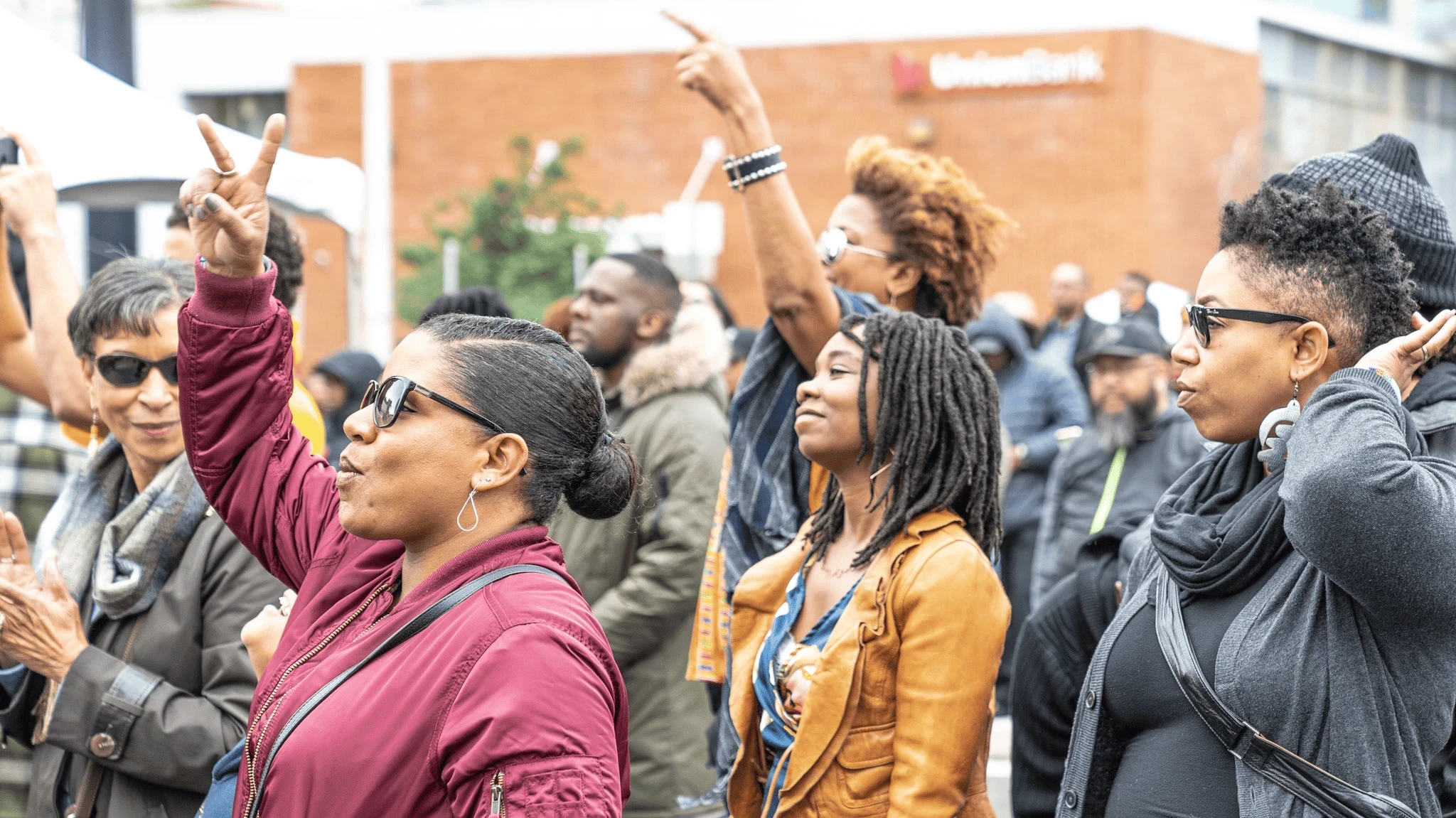
This is where a community helps. The Union is a shared space where entrepreneurs, artists, educators, and creators work side by side, so getting ten honest reactions in the Commune or between meetings on the 20th floor is far easier than polling friends who already know your idea. Even a CoMmunity membership brings VIP event access, where you can float a name to people who make things for a living.
Her winner: The Question Jar, with the tagline "Real questions from real kids, answered for the grown-ups who love them." Parents remembered it, and almost everyone guessed the premise correctly.
Building a visual identity that works at thumbnail size
Your cover art is your storefront. In most podcast apps it appears very small, sometimes not much bigger than a fingernail on a phone screen. Design for that size first and the large version will take care of itself.
Current technical specs (check before you upload)
Apple Podcasts: square artwork, minimum 1400 x 1400 pixels and maximum 3000 x 3000 pixels, JPEG or PNG, RGB color space. Most creators upload at 3000 x 3000 so it looks sharp everywhere.
Spotify and other platforms: also use square art and generally accept files that meet Apple's specs, though exact requirements differ by platform and change from time to time. Always check the current guidelines in your podcast hosting dashboard before you submit.
YouTube: if you plan a video version, you will also need wide 16:9 thumbnails and channel art. That means your visual system needs to stretch beyond one square.
Design principles for small screens
Three elements, maximum. Typically your show name, one image or graphic, and a background color. Guest names, taglines, and logos crammed into a tiny square become noise.
Big, bold type. If the title is not readable at the size of a postage stamp, make it bigger or cut words.
High contrast. Light text on dark backgrounds, or the reverse. Avoid thin fonts and similar-value colors.
Pick two or three brand colors. Use them consistently across cover art, social posts, thumbnails, and set design.
Choose one or two fonts. A display font for the title, a clean readable font for everything else.
Know your neighbors. Search your category in a podcast app and screenshot the top shows. If everything is blue and white, a warm orange might stand out.
The host photo question
Should your face be on the cover? For host-driven shows, a strong photo builds trust fast. Parents choosing a show for their family want to know who is talking to them, so Tasha decides yes: a warm, well-lit photo of her holding a glass jar full of folded paper questions.
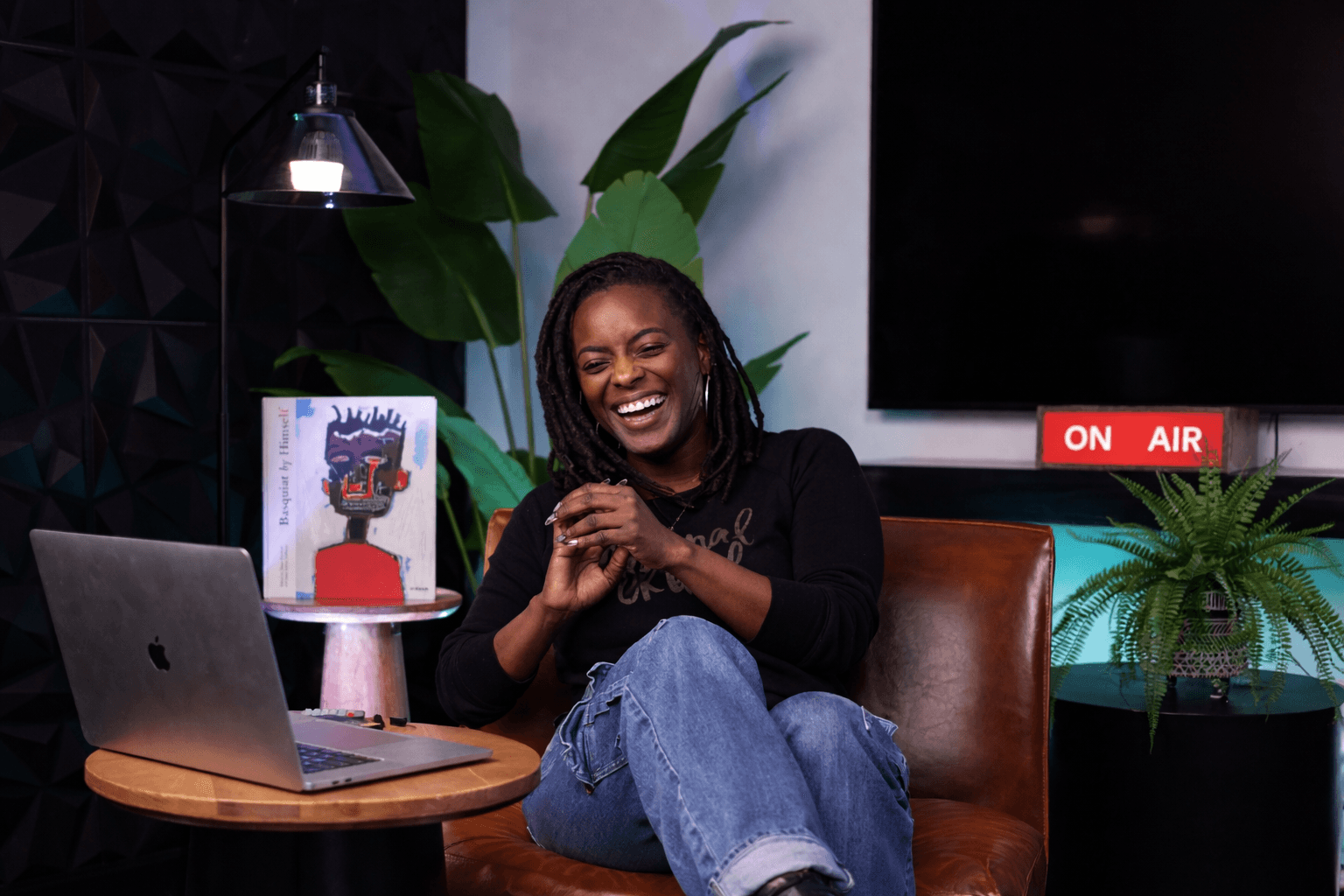
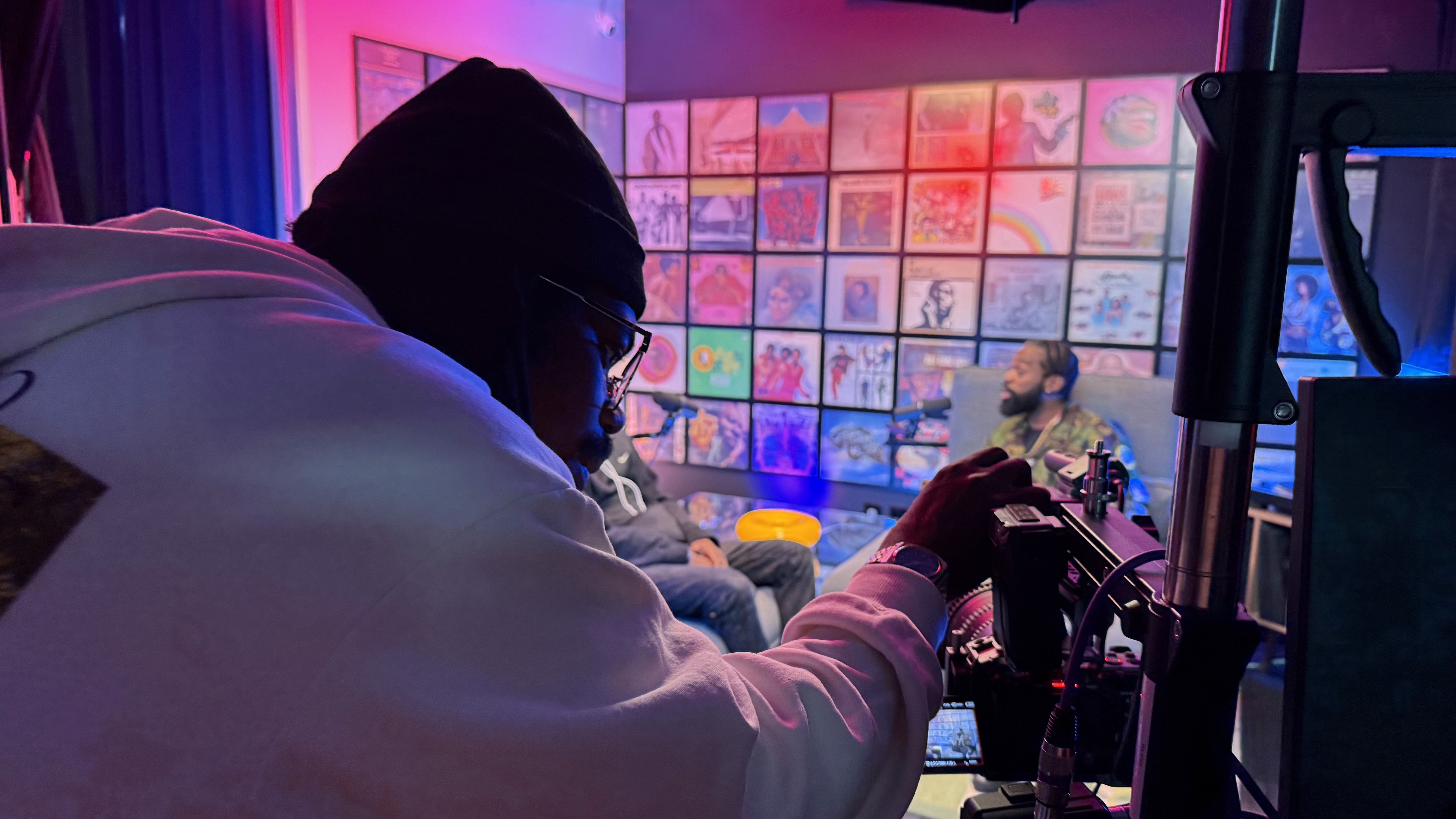
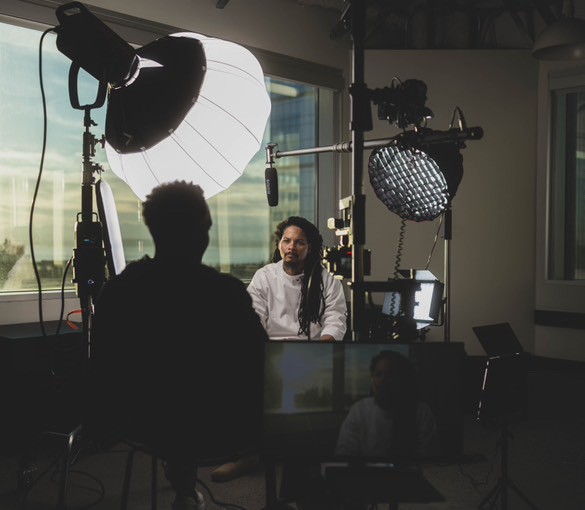
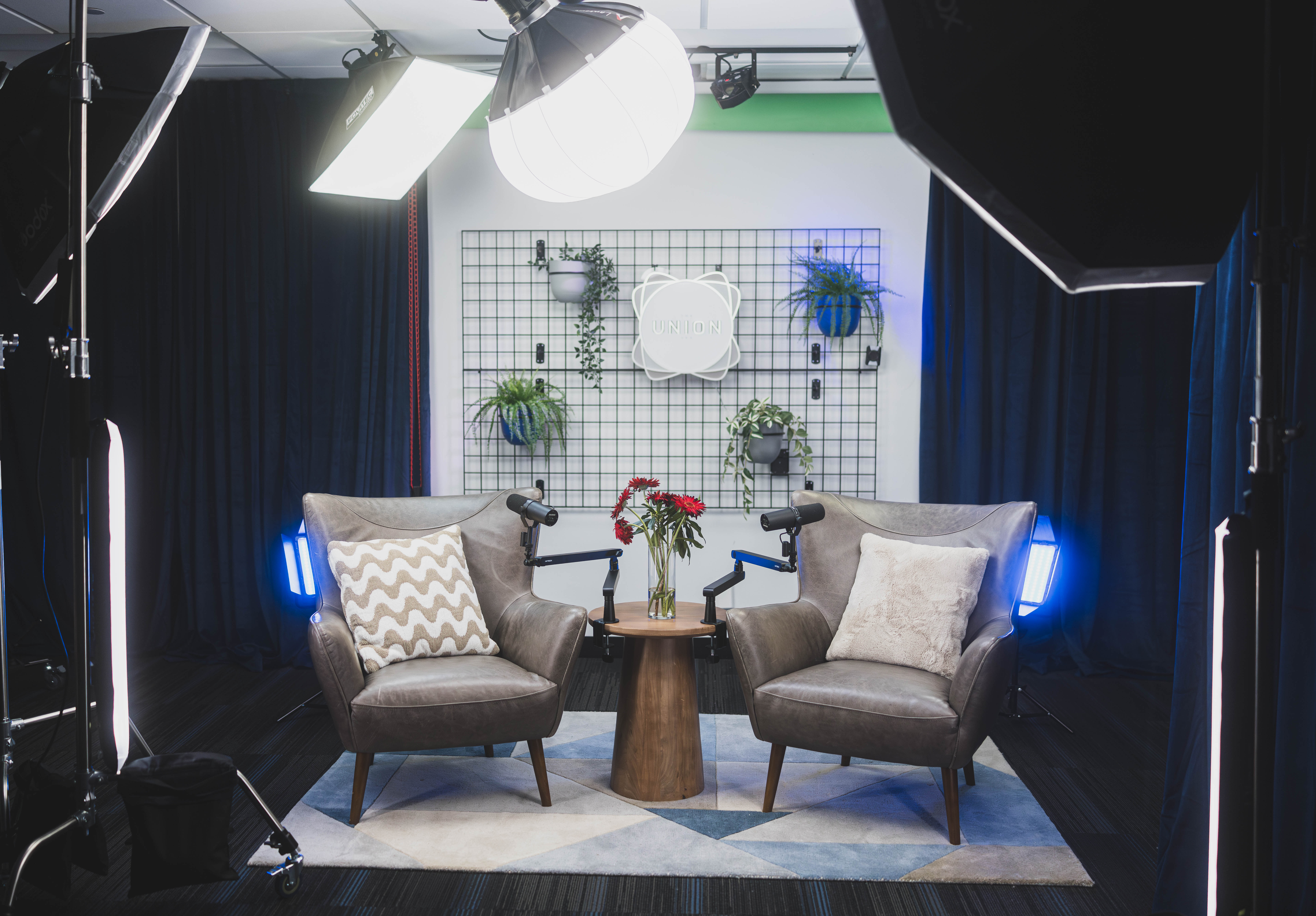
A phone snapshot in her classroom will not cut it, and this is where The Union's production studio earns its keep. The Media Lab includes two purpose-built studios, the Blue Room ("Blue Pill") and the Red Room ("Red Pill"), each with a range of sets. Modular sets and color backdrops can switch from a talking head to a product shoot without a long reset, which is exactly what you want when you are trying three looks for cover art in one session. You can compare options side by side, from sets like QT's Corner in Red Pill to The Cove or The Grid in Blue Pill. With cinema and vlog camera bodies on hand, you are not limited to whatever gear you own.
The production team also offers custom set design: backdrops, lighting setups, furniture layouts, and visual themes built around your brand. If you want your recording set to match your cover art colors (so every video clip looks like it belongs to the same show), that is a conversation worth having before your first recording day. You can browse the studios on the spaces page to picture which set fits your show.
Defining a voice that travels across platforms
Your brand is more than a logo. It is how your show sounds and reads everywhere it appears: the first ten seconds of an episode, a caption under a clip, a reply to a listener comment, the bio on your profile. If those feel like four different people wrote them, listeners notice, even if they cannot say why.
Write a one-page voice guide
You do not need a corporate brand book. You need a single page that answers:
Three words that describe your tone. Tasha picks "curious, warm, accurate."
Three words you are not. Hers: "lecturing, cutesy, rushed." Defining the opposite is often clearer than defining the target.
Who you are talking to. One specific listener. Tasha writes: "A parent driving home from soccer practice whose eight-year-old just asked something they couldn't answer."
Signature phrases. A consistent opening line and sign-off. Hers opens with "Today's question comes from..." and ends with "Keep asking."
Words and habits to avoid. For her, unexplained jargon and answers that talk down to kids.
Adapt the format, keep the voice
Your voice stays steady while the format changes by platform. On the podcast feed, Tasha has room for a full story. On Instagram, the same voice becomes a one-line hook: "Do fish get thirsty? A third grader wants to know." On YouTube, it becomes a bold thumbnail with the question in giant type. Same curiosity, same warmth, different container.
The Union's content strategy services specifically include brand strategy, audience targeting and research, and voice, tone, and messaging. A strategy session with a producer can pressure-test your voice guide against your actual audience before you record twenty episodes in a tone that does not land. Its delivery services (editing, short captioned clips, thumbnails, pull-quotes, show notes and publishing copy, plus social media promotion) are also where brand consistency either holds or falls apart, so it helps to bring your voice guide to that team early. You can see the full scope on the services page.
Common branding mistakes (and easy fixes)
Choosing a name only you understand. Inside jokes rarely translate. Fix: run the radio test with strangers.
Skipping the availability check. Discovering a conflict after launch means rebranding with an audience watching. Fix: check directories, handles, domains, and trademarks first.
Designing art at full size only. Fix: shrink your draft to roughly 100 pixels wide and look at it on your phone.
Too many fonts and colors. Fix: two fonts, two or three colors, written down in your voice guide.
Changing the look every few weeks. Recognition comes from repetition. Fix: commit for at least your first season.
Treating video as an afterthought. If you might film later, plan for wide thumbnails and a set that matches your brand now.
Your branding checklist
Work through these in order. Each step builds on the one before it.
Write 50 possible names in one sitting, then narrow to 10.
Check each finalist across Apple Podcasts, Spotify, YouTube, major social platforms, domains, and the USPTO Trademark Search.
Test your top two or three names out loud with at least ten people, asking what they remember a day later.
Choose your name and write a plain-language tagline of 15 words or fewer.
Pick two or three brand colors and one or two fonts.
Decide whether your face goes on the cover, and plan a photo session if so.
Draft cover art at 3000 x 3000 pixels and test it at thumbnail size on your phone.
Write your one-page voice guide: tone words, anti-tone words, target listener, signature phrases.
Draft a show description that uses the plain search terms your name does not.
Secure your handles and domain the same day you commit.
Do this this week
Set a 30-minute timer and write 50 names. Do not stop to judge. Tomorrow, pick your five favorites and run the availability check on each. By the end of the week, say your top two names out loud to five people, then ask them the next day which one they remember and what they think the show is about. Write down their exact words. If their description matches your premise, you have your name.
If you want to go further, sketch your cover art on paper at the size of a sticky note. If you cannot read your title at that size, neither can a listener scrolling on the bus.
Tasha ended her week with a name, a tagline, a three-word voice, and a rough sketch of a jar full of questions. She did not have polished art yet, but she had a clear brief, which is the thing that makes a photo session or a designer's time productive instead of expensive guesswork.
Coming up next
In Part 5, Building a Content Calendar, Tasha turns her jar of thirty kid questions into a realistic publishing plan, and you will learn how to map episodes, recording days, and promotion so you never face a blank week.
Start your story at The Union
You do not need to own a camera or have every answer to build a show people recognize. The Union exists so Seattle's educators, entrepreneurs, artists, and creators have the space, the sets, and the people to start. If you want honest feedback on your name, a strategy session on your voice, or a walkthrough of the sets where your cover photo could come to life, the team would love to hear from you.
Email contact@theunion.io or call 206-551-0964 to talk it through. You can book the studio as a guest by appointment, no membership required. Ready to make it your creative home? Apply for membership: the CoMmunity membership is $50/month with no sign-up fee and includes discounted consultations and VIP event access, and the CoCreate Podcast membership is $300/month (with a $100 sign-up fee and 2-month commitment) for access to the media lab for DIY and full-service productions. CoCreate currently has a waitlist of about one month, so applying now means you will be ready by the time your brand is.
The full series
This is Part 4 of 24 in Starting a Podcast at The Union (Content Strategy stage). Previous: Part 3, Interview, Solo, or Story? Choosing Your Podcast Format and Schedule. Next: Part 5, Never Stare at a Blank Week Again With a Simple Content Calendar.