Podcasting
·
Oct 15, 2026
Never Stare at a Blank Week Again With a Simple Content Calendar

Arif Gursel
Founder

Here is a truth that surprises most new podcasters: the hardest part of making a show is rarely the recording. It is sitting down on a Tuesday night, tired after work, and realizing you have no idea what this week's episode is about. That moment is where most shows quietly stall. The cure is a content calendar, a simple plan that tells you what you are making, when you are recording it, and when it goes out into the world.
In Part 4 you named and branded your show. Now it is time to give that brand a rhythm. This post walks you through planning a full season, batching your topics so you record several episodes at once, and building a calendar you will actually keep. Along the way we will check in with Tasha, our illustrative creator, and show how The Union can serve as your home base while you plan.
Why consistency beats intensity
Plenty of new podcasters launch with a burst of energy: three episodes in the first week, a flood of social posts, late nights editing. Then life happens. A busy month at work, a sick kid, a broken laptop, and suddenly the show has not published in six weeks. Podcasters even have a name for this: "podfade."
Podcast directories list millions of shows, but only a fraction of them have published a new episode in the last few months. Exact figures shift constantly, so if you want a current snapshot, look at the public stats from podcast search tools like Listen Notes or industry newsletters like Podnews. The pattern, however, has held for years: starting is common, continuing is rare.
Consistency matters for three practical reasons:
Listeners build habits. If your show reliably drops every other Thursday, people fold it into their routine: the school drop-off, the dishwasher, the Saturday run.
You build skill. Every episode you finish teaches you something about pacing, editing and interviewing. Steady output compounds.
You build trust with guests and partners. A show with a clear schedule is easier to say yes to.
A modest schedule you can sustain for a year will almost always outperform an ambitious one you abandon in a month.
Meet Tasha at the planning stage
As a quick refresher: Tasha is an illustrative example we are following through this series. She teaches middle school science in Rainier Valley, and her podcast is for parents of curious kids. Each episode answers one real question a kid asked. In Part 4 she landed on a show name and a look she loves.
Now she is staring at the next problem. She has a notebook full of student questions ("Why is the sky blue but sunsets are orange?" "Do fish sleep?" "Could Mount Rainier erupt while I'm at school?"), but no idea which ones to do first, how often to publish, or how to fit any of this around grading and parent-teacher conferences.
Tasha's instinct is to publish weekly forever. Her teacher brain, which plans units months in advance, tells her there is a better way. She decides to treat her podcast like a curriculum: a defined season with a beginning, middle and end.
Plan in seasons, not forever
A season is a batch of episodes released on a regular schedule, followed by a planned break. It is the single most useful mental shift for a new podcaster because it turns an endless obligation into a finishable project.
How long should a season be?
For a first season, aim for 8 to 12 episodes. That is long enough to build a habit with listeners and give new visitors a meaningful back catalog, and short enough that you can see the finish line from the start. After the season ends, take two to six weeks off to rest, review what worked, and plan the next one.
Major platforms support this structure. Apple Podcasts and Spotify both display season numbers when your hosting provider includes them in your feed, and Apple lets you label your show as "episodic" (listeners can start anywhere) or "serial" (listeners should start at episode one). Settings and display options change over time, so check your hosting provider's current documentation when you set up your feed. Tasha's show is episodic: any parent can jump into any question.
Pick a cadence you can keep
Your cadence is how often you publish. Common options:
Weekly: builds momentum fastest, but demands the most time. Realistic if you batch aggressively or have production help.
Every two weeks: the sweet spot for many solo creators with day jobs.
Monthly: workable for longer, research-heavy or highly produced episodes, though it takes longer to build listener habits.
To choose, estimate your real time cost. For a beginner, a 25 to 30 minute episode can easily take four to eight hours in total once you count research, recording, editing, show notes and promotion. That range varies a lot depending on format and how much help you have. Multiply your per-episode hours by your cadence and ask honestly whether that fits your month.
Tasha does the math. Weekly would eat her weekends during the school year. She chooses every two weeks, with a 10-episode season that starts in late September and wraps before winter break. It follows the rhythm she already lives by.
Build an episode bank before you build a calendar
Before you assign dates, you need a pool of ideas to draw from. Think of it as an episode bank. The rule of thumb: brainstorm at least two to three times as many ideas as episodes you plan to publish. If your season is 10 episodes, collect 20 to 30 ideas. Many will turn out to be weak, overlapping or too hard to book, and that is fine. Having extras is what keeps you from staring at a blank mic.
Group ideas into content pillars
Content pillars are three to five recurring themes your show returns to. They make your show feel coherent and make brainstorming easier, because each pillar becomes its own prompt.
Tasha sorts her student questions into four pillars:
Our Backyard: local science, like Seattle rain, salmon runs and Mount Rainier.
Your Amazing Body: sleep, hiccups, why scabs itch.
Up There: space, weather and the sky.
Weird Animals: the questions kids love most.
Now she can balance her season so it does not run four space episodes in a row.
Mix your episode formats
Varying format keeps both you and your listeners engaged. Consider a mix of:
Solo episodes: you explain the answer yourself. Easiest to schedule.
Guest episodes: an expert, practitioner or interesting person joins you.
Recurring guest or segment: someone who appears every few episodes, giving the show a familiar second voice.
Listener or community episodes: you answer submitted questions or feature voices from your audience.
Tasha plans roughly half solo episodes (she can record those anytime) and half guest episodes, plus a season finale where she answers a rapid-fire batch of short questions.
Where your recurring guests come from
Guest episodes are often a show's best content, and also its biggest scheduling headache. This is where your environment matters as much as your plan.
The Union is a shared space for local entrepreneurs, artists, educators and creators, rooted in cooperative economics. When you work alongside people building their own projects, potential guests stop being strangers you cold-email and start being people you already know from the kitchen in the Commune or a workshop at The Union. Workshops, community programming and VIP access to events The Union produces give you natural, low-pressure ways to meet people whose expertise fits your show.
Picture how this could play out for Tasha. Say she meets a fellow member, an illustrator who draws science diagrams for children's books, at a community event. Over coffee they realize the illustrator could join every third episode to describe how she would draw the answer. That is a recurring segment born from proximity. (This is an illustrative scenario, but it is exactly the kind of connection a creative community makes easier.)
When you plan guest episodes, a few logistics affect your calendar:
Book guests four to six weeks ahead when you can. Busy experts fill their calendars fast.
Always have a backup. Pair each guest episode with a solo episode you could record in its place if the guest cancels.
Make it easy to say yes. The CoCreate Podcast membership includes pre-paid parking for host and guests, which removes one of the most common downtown hassles for visitors.
Batch your work so the mic never sits empty
Batching means grouping similar tasks together: researching several episodes in one sitting, recording several in one session, editing several in one block. It is the single biggest time-saver in podcasting because every task has a warm-up cost. Setting up, getting into the right headspace, checking levels: you pay that cost once per batch instead of once per episode.
A sample batching rhythm
Here is how a biweekly creator might structure a month:
Week 1: research and outline three or four episodes.
Week 2: one recording session that captures two or three episodes back to back.
Week 3: edit and write show notes for the batch.
Week 4: schedule releases, create social clips, start research for the next batch.
Most podcast hosting platforms let you upload episodes in advance and schedule their release date and time, so a single recording day can fill several weeks of your calendar.
How the studio supports batching
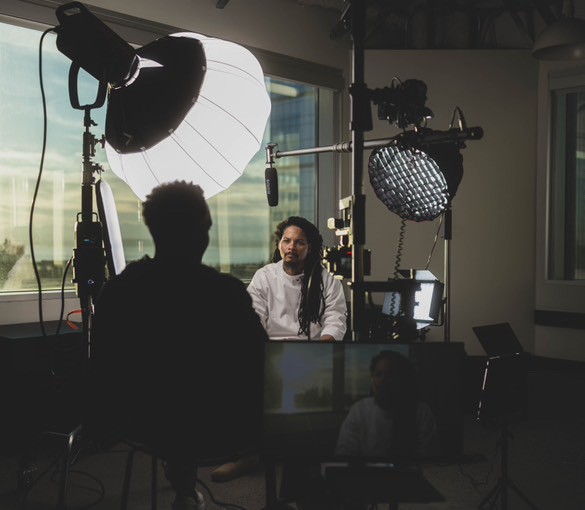
Batch recording works best in a space built for it. The Union has two production studios, Blue Pill and Red Pill, each with multiple sets. Blue Pill's sets include The Cove and The Grid, and Red Pill's sets include Talk Show and QT's Corner, so you have a range of sets to choose from. The modular sets and color backdrops are designed to switch from a talking head to a panel without a long reset, which can help you record a solo episode and a guest episode in the same session.
A teleprompter screen can hold your host notes, handy when you are recording three outlines in a row and do not want to shuffle paper. And if you work with a remote editor, the integrated Blackmagic Cloud storage keeps them in the loop.
For Tasha, the plan becomes two recording days per season block: one day in September to capture her first four episodes, and a second session in October for the rest. You can explore all the sets on the spaces page to imagine which ones match each of your episode formats.
Build a launch buffer
Before your first episode goes live, have at least three episodes fully finished, and ideally more. Many creators launch with two or three episodes at once so new listeners have something to binge, then keep a buffer of two finished episodes in reserve at all times.
The buffer is your insurance policy. When a guest cancels, a cold knocks out your voice, or report cards are due, the show keeps publishing on schedule while you catch up. Without a buffer, every small disruption becomes a missed episode.
Tasha decides to launch with three episodes on day one, then hold two in reserve throughout the season. Her September recording day covers both.
The calendar itself: what to track
Your content calendar can live in a spreadsheet, a project management tool or a paper planner. The tool matters far less than the fields. At minimum, track:
Episode number and working title
Content pillar and format (solo, guest, recurring segment)
Guest name and confirmation status
Research deadline
Record date and location (for example, which studio set)
Edit deadline
Publish date
Promotion assets needed (clips, thumbnail, show notes, social posts)
Status (idea, outlined, recorded, edited, scheduled, published)
Do not forget the promotion column. A finished episode still needs short clips, a thumbnail and publishing copy. If you plan to work with The Union's production team, these are part of what their post-production includes: mixed audio, a clean video cut, short captioned clips, thumbnails, pull-quotes, show notes and publishing copy. Knowing that ahead of time changes how much time you block for yourself.
Also mark seasonal hooks: back-to-school, holidays, local events and anything timely for your audience. Tasha slots her "Why do leaves change color?" episode into mid-October and saves "Why is it so dark in winter?" for December.
Your step-by-step calendar checklist
Choose your season length (8 to 12 episodes) and cadence (weekly, biweekly or monthly).
Estimate your hours per episode and confirm the schedule fits your real life.
Define three to five content pillars.
Brainstorm two to three times as many episode ideas as you need.
Pick your season's episodes, balancing pillars and formats.
List potential guests and send invitations four to six weeks before record dates.
Assign a backup solo episode to every guest episode.
Block your batch recording days and book the studio.
Set edit, promotion and publish deadlines working backward from each release date.
Build your buffer: three episodes ready at launch, two in reserve.
Common calendar mistakes to avoid
Overcommitting. Starting weekly when biweekly fits your life. You can always speed up later.
No buffer. Publishing the same week you record leaves zero margin for error.
Front-loading your best ideas. Spread your strongest episodes across the season so the middle does not sag.
Ignoring promotion time. Clips and show notes take real hours. Schedule them.
Planning alone in a vacuum. Your calendar improves when someone experienced pressure-tests it.
That last point is worth pausing on. The Union's content strategy services cover pre-production planning, audience targeting and research, and producer research. Before a session, producers align on premise and audience and prep a run-of-show. A planning conversation with a producer can catch problems (an unrealistic cadence, a guest-heavy month, a missing promo step) that would otherwise cost you weeks. Browse the services page to see what that support covers.
A home base for planning
Planning happens best somewhere other than your couch. CoCreate Podcast members can plan, record and edit under one roof: the meeting rooms and office spaces on the 20th floor are available first come, first served for calls and small group sessions, The Corner and the Commune are also part of the 20th floor, and there is a dedicated pre/post-production room for editing. Members have access 24/7 Monday through Friday, which matters when your creative window opens after the school day ends.
That is part of what makes The Union genuine infrastructure for Seattle's creative economy. You do not need to own gear, rent separate spaces for meeting, recording and editing, or figure everything out alone. Even Jolyn GC, a member who records her podcast Wealth Rituals at The Union, works from the same home base newcomers use.
Do this this week
Give yourself one focused hour and complete these four steps:
Write down your season length and cadence, plus your honest estimate of hours per episode.
Name three to five content pillars for your show.
Brainstorm 20 episode ideas, at least four per pillar.
Circle the three you would most like to launch with, and write one name next to any that would benefit from a guest.
That single page is the skeleton of your first season. Tasha finished hers at her kitchen table in under an hour, and for the first time the show felt real.
Coming up next
In Part 6, Booking a Strategy Session, Tasha takes her draft calendar to a producer and learns what an expert set of eyes can sharpen before she ever hits record. We will walk through what to bring, what to ask and how to leave with a clear plan.
Start your story at The Union
You have a calendar taking shape. Now give it a home. If you want a place to plan, record in batches and meet the community members who could become your recurring guests, the CoCreate Podcast membership is $300 per month with a $100 sign-up fee and a two-month commitment. It includes the media lab for both DIY and full-service productions, plus pre-paid parking for you and your guests. CoCreate memberships currently have a waitlist of about a month, so applying now lines up nicely with planning your first season. If you would like to start smaller, the CoMmunity membership is $50 per month with no sign-up fee, and includes VIP event access and discounted consultations.
Not ready to commit? You can book the studio as a guest by appointment, weekdays from 9 AM to 5 PM, and try a batch recording day. When you are ready for a home base, apply for membership. Have questions, or want a walkthrough of the sets before you plan your recording days? Email contact@theunion.io or call 206-551-0964. Come see us at 1200 2nd Ave in downtown Seattle. Your first season starts with one page and one conversation.
The full series
This is Part 5 of 24 in Starting a Podcast at The Union (Content Strategy stage). Previous: Part 4, Two Seconds to Win a Listener: Naming and Branding Your Show. Next: Part 6, Stuck on a Launch Date? How a Strategy Session at The Union Helps.